
The guidance on this site is based on our own analysis and is meant to help you identify options and narrow down your choices. We do not advise or tell you which product to buy; undertake your own due diligence before entering into any agreement. Read our full disclosure here.
What is run-off insurance, and who really needs it?
Run-off cover (also known as 'tail' or 'extended reporting' cover) is critical for those working in fields or running businesses where professional indemnity insurance or directors & officers insurance are key elements of risk management, such as architects, accountants, finance professionals, surveyors and other professional fields. Before you retire, change jobs, close your business or otherwise stop trading, make sure you're well protected with run-off insurance because liability claims can be brought years after the fact.
Tables of Contents
- What is 'run-off' insurance?
- Why is run-off insurance important?
- Who needs run-off insurance?
- How much does run-off insurance cost?
- How long do I need run-off cover?
'Run-off' insurance definition
'Run-off' or 'tail' cover typically refers to a type of professional liability insurance that a business or person uses after they stop trading—for instance in case of death or retirement.
It protects against claims that are made during an extended reported period against work done earlier, while the business was still actively trading and fully insured. It does not cover new business written during the extended reporting period, and in fact there should be no further business carried out if a run-off policy is in place. If trading does continue, it should be under a new business name and a fresh insurance policy, in parallel to the run-off coverage.
Run-off cover can be purchased in the form of professional indemnity insurance or directors & officers insurance, or both.
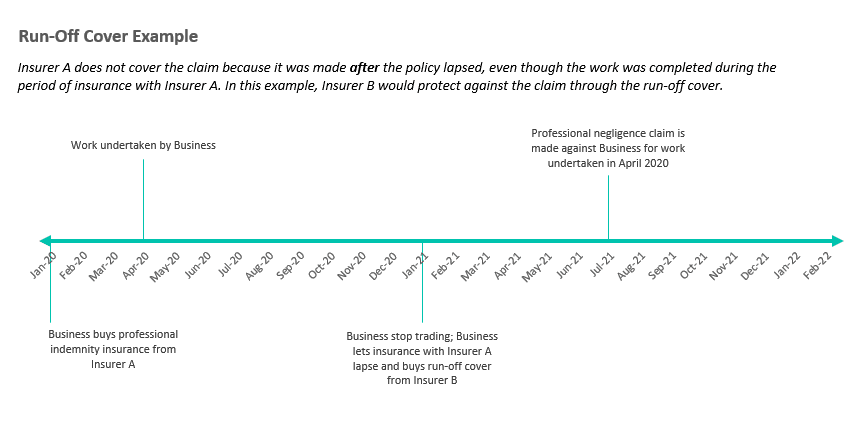
Example:
- An architect retires and closes his business in January 2026, letting his professional indemnity insurance policy lapse. Six months later in July 2026 he is sued for work he completed in April 2025 on a large commercial project. Without tail insurance he would have no cover; with run-off professional indemnity insurance this claim would be covered.
Why is run-off insurance important?
Run-off insurance is necessary because professional liability insurance is typically written on a 'claims-made' basis. This means that you only have protection if you hold a valid insurance policy when the work was undertaken AND when a claim is made. So if you retire or your business stops trading and you let your professional liability insurance lapse without run-off insurance, you are at risk of liability claims.
Who needs run-off insurance?
If you were a director or officer of a company, or you or your business gave professional advice or service as part of your work, then you might want run-off insurance when you retire, change careers or otherwise stop trading. As claims can arise years after work was undertaken, a professional might need run-off insurance even after death. This is an issue to raise with the executor of a professional's estate unless they have been long retired.
How much does run-off insurance cost?
While run-off premiums typically decrease as the risk of a new claim diminishes over time, they are subject to current 'hard market' conditions. Since late 2024, architecture and construction professionals have seen higher costs due to stricter underwriting following the Building Safety Act. Furthermore, insurers are now more reluctant to offer run-off quotes if they did not provide the primary policy for at least a year prior. You should budget for the first year of run-off to cost roughly the same as your final trading year's premium.
It's more likely that an issue will arise closer to the time the work was undertaken than many years later—so the further away you get from the time the work was undertaken, the less likelihood of a claim, which means less risk for the underwriter and a lower insurance premium. And once you stop trading, you're no longer adding to the basket of work that could potentially result in a claim.
How much run-off cover do I need?
The amount of run-off cover you need depends very much on your unique situation. Professional requirements have significantly tightened in recent years. For example, ICAEW (Accountants) updated their regulations in September 2024, increasing the minimum indemnity limit for many smaller firms to £250,000 (or 2.5 times fee income). While a six-year period remains a common benchmark, RICS (Surveyors) now strongly recommends—and in high-risk categories like valuations or fire safety, may require—run-off cover for up to 15 years. This aligns with the 'long-stop' statutory limitation for latent defects and reflects the increased risks in the built environment.
Where can I get a run-off cover policy?
You are best approaching your existing insurer for a run-off quote, as insurers don’t like to quote run-off without having held a business’ insurance policy for at least a year beforehand. This is due to the industry belief that run-off coverage is a courtesy to clients, giving them peace of mind in their retirement.
In many cases where a business activity is unlikely to result in a claim until months or even years later (i.e. construction design and calculation), the risk an insurer is taking when providing run-off is about the same as for a practicing business until a year or two have passed. For this reason it’s worth checking what the run-off terms and conditions are with your existing insurer at renewal, even if you don’t plan on retiring for some time. If the terms aren’t favourable, consider switching insurer a year or two before retirement.
How long do I need run-off cover?
Standard professional negligence claims generally have a six-year limitation period. However, in today's market, this is often insufficient. If work was performed under a Deed (common in design and build), the liability period extends to 12 years. Furthermore, the 'long-stop' for latent defects is 15 years. For many professionals, especially those involved in projects with collateral warranties, maintaining run-off for at least 12 to 15 years is now considered the necessary standard for full protection.
With that in mind, those with professional liability exposure might want to carry run-off insurance for 6 years after they stop working, but you can discuss your needs with a specialist broker or directly with your insurance company.