
The guidance on this site is based on our own analysis and is meant to help you identify options and narrow down your choices. We do not advise or tell you which product to buy; undertake your own due diligence before entering into any agreement. Read our full disclosure here.
Cheap Car Insurance for First Time Drivers
Cheap auto insurance for first time drivers
- You could save up to £515*
- 4.8 out of 5 stars on Reviews.co.uk**
- Cheap quotes from 100+ providers
What is first time driver insurance?
First time driver insurance is protection for those who have recently passed their tests. It's required by law and protects both them and other people on the road. There are a few types of first time driver insurance, so be sure to understand your options before buying a policy.
The penalties for being caught without car insurance include hefty fines, points on your licence, higher insurance premiums and even disqualification from driving.
Is first time driver insurance more expensive?
Yes, cheap car insurance is harder to find for first time drivers, because cover is usually more expensive for this group. Why? First time drivers have less on-the-road experience, so insurers think first time drivers are riskier and more likely to have an accident.
Because of the higher likelihood of a claim, insurers charge higher premiums for first time drivers.
How much does car insurance cost for a first time driver?
Car insurance for a first-time driver now costs between £1,300 and £1,500 as a median figure, following a sustained period of falling premiums throughout 2025. While rates remain high due to repair cost inflation, new drivers are seeing significant relief compared to recent years.
NimbleFins’ 2026 market tests show that a 20-year-old first-time driver can expect to pay approximately £1,350 to insure their vehicle. In contrast, a first-time driver aged 25 would pay around £730—representing a substantial 46% price drop as drivers move out of the highest-risk 'young driver' bracket.

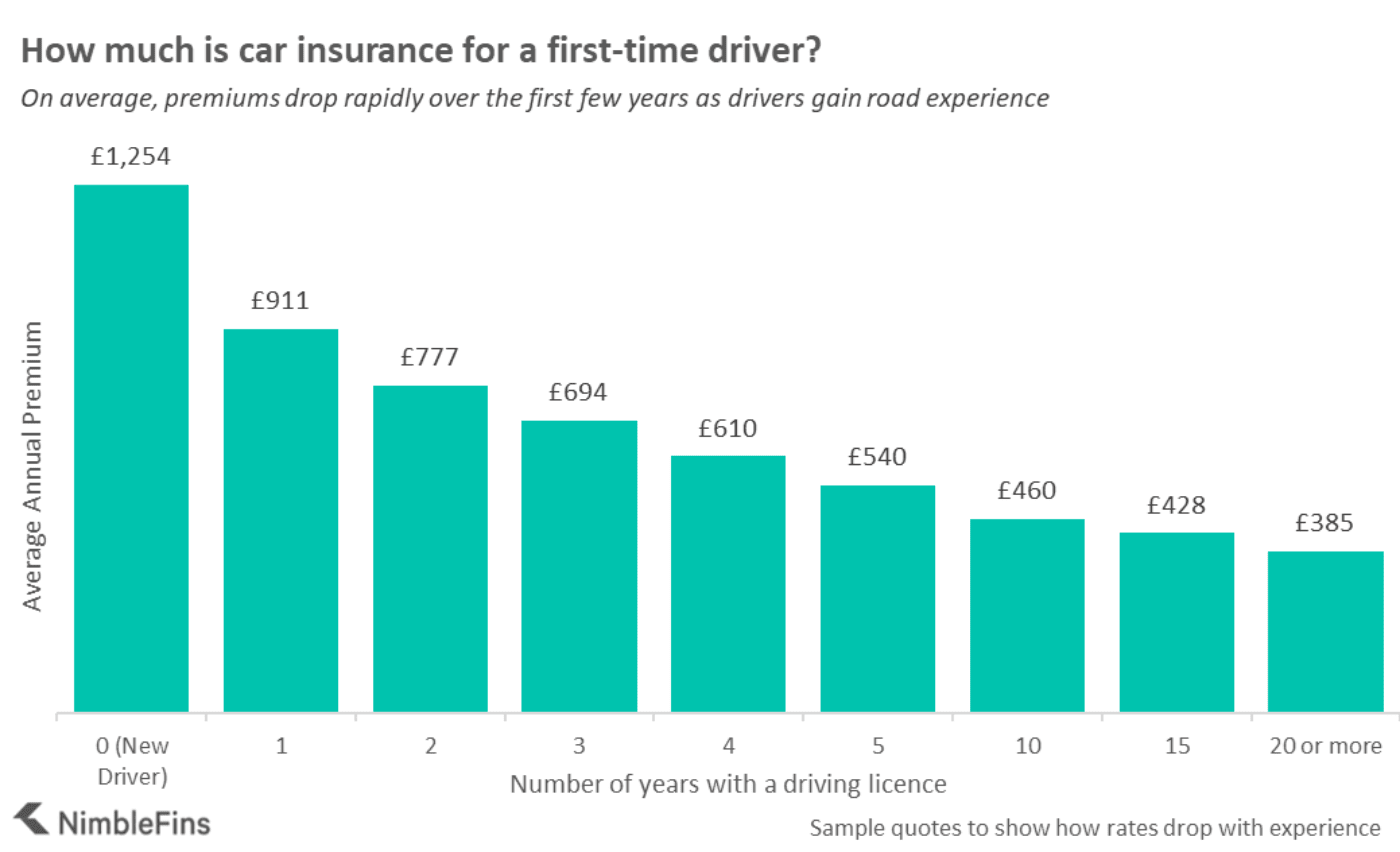
The table below reflects the current 2026 median premiums based on years of driving experience. Generally, premiums drop significantly after the first year as drivers build their No Claims Bonus (NCB) and move out of the highest-risk brackets.
| Number of years with a driving licence | Median annual premium | Estimated Decrease |
|---|---|---|
| 0 (New Driver) | £1,121 - £1,387 | n/a |
| 1 | £850 - £972 | ~24% - 31% |
| 2 | £720 - £834 | ~13% |
| 3 | £668 - £720 | ~14% |
| 4 | £580 - £640 | ~11% |
| 5 | £500 - £580 | ~10% |
| 10 | £420 - £500 | ~15% |
| 15 | £405 - £450 | ~8% |
| 20 or more | £364 - £405 | ~10% |
As always, your rates will certainly vary; this information is meant to be informative regarding general market pricing of risks.
What kind of car insurance do first time drivers need?
Those who've recently passed their driving test (congratulations!) can choose between the following three tiers of car insurance:
| Types of first time driver insurance | |
|---|---|
| Third Party Only (TPO) | The lowest tier of car insurance, and the minimum coverage required by law. TPO only covers damage to other people's property or injuries to other people. TPO does not cover damage to your own car. |
| Third Party, Fire and Theft (TPFT) | TPFT car insurance provides the mandatory third party coverage required by law and also covers damage to your car resulting from fire, theft or attempted theft. |
| Comprehensive | The best tier of car insurance, comprehensive covers third party damage or injury AND damage or loss of your car due to fire or theft AND damage to your car from an accident where you're at fault (only comprehensive policies cover this last bit). |
Top tip 1: It's also worth mentioning telematics policies. These track the way you drive (e.g. speed, cornering and braking) and so first time drivers who demonstrate safe driving habits should get cheaper premiums the subsequent year.
Top tip 2: New drivers might expect to pay more for comprehensive cover, but surprisingly this (the highest tier of cover) may actually be cheaper than lower tiers. Before opting for TPO or TPFT assuming you're saving money, it is important to get quotes for comprehensive cover as well. It could provide much better value for money.
Cheap first time car insurance
First time drivers can try to lower the cost of their insurance by keeping the following tips in mind:
1. Choose a telematics (black box) insurance policy
Telematics policies are cheaper in many cases for first time drivers. These systems track the way you drive (e.g. speed, cornering and braking) and first time drivers who demonstrate safe driving habits should get cheaper premiums.
2. Add a named driver
Adding a more experienced, older driver to your policy can lower the premium on a first time driver policy. By adding a second driver, it's assumed you won't be behind the wheel 100% of the time, mitigating some of the risks associated with first time drivers.
However, don’t fall into the trap of fronting and be tempted to list the named driver as the main driver in order to get cheaper car insurance. Fronting is insurance fraud so not only will it invalidate your policy, you’ll be committing a crime, too.
3. Choose a cheaper car
Choose a car that would cost less for the insurer to repair or replace if you should be in an at-fault accident while you're gaining valuable road experience. Look for a car with a lower market value and a lower insurance group. (All cars belong in one of 50 car insurance groups, based on value, engine size, the cost of repairs and parts and safety features.)
4. Consider all levels of cover
Surprisingly, the highest tier of cover (comprehensive) might be the cheapest for new drivers. This is because drivers who are interested in protecting their own car through comprehensive cover are known to be more careful behind the wheel than drivers who aren't concerned with protecting their car through insurance.
5. Increase your excess
The excess is an amount you have to pay in order for a claim to go ahead. There are two types of excess:
- Compulsory excess: a fixed amount set by your insurer.
- Voluntary excess: an additional amount you agree with your insurer.
You must pay both excesses in a claim goes forward. First time drivers might find a lower premium if they take on more of the risk, by opting for a higher voluntary excess. But remember it needs to be affordable should you need to claim.
6. Never auto renew
Given the high price of first time driver insurance, it's particularly important to check the market and compare quotes when it comes time to renews. You might find quite high premiums for a few years as you gain experience and a no claims history, so it's important to see which insurance providers most want your business each year.
7. Complete an advanced driving course
Some insurers will discount your premium if you’ve completed an advanced driving course, such as Pass Plus. The discounts vary but given the high rates, first time drivers might save a noticeable amount this way.
For other money-saving tips related to all drivers, read our extended article on how to get cheap auto insurance.
Cars for first time drivers with cheap insurance
The most economical cars for new drivers in 2026 continue to be small hatchbacks with low-powered engines. While the Citroen C1 has been phased out of new production, it remains a top used-market choice alongside the Kia Picanto and the Hyundai i10. Our 2026 market tests confirm that these models are still roughly 22% cheaper to insure than larger or more powerful alternatives like the VW Polo, Ford Puma, or the Skoda Fabia. Interestingly, the Fiat 500 (Mild Hybrid) has also emerged as a competitive option, often undercutting the premiums of 'crossover' models like the VW T-Roc by up to 25%.
When looking for a cheap car to insure, first time drivers should consider two primary factors:
- the market value of the car (lower is better)
- the insurance group of the car (lower is better)
There is some correlation between these two factors, in that a car with a lower market value is likely to have a lower insurance group, and vice versa. But there are also many other data points factored into the insurance group. Regardless, both of these factors impact an insurance quote.
Simply put, a lower market value means a lower max payout on comprehensive policies for accident damage or theft—because insurers won't pay out more than the market value, a lower market value means less risk for the insurer, and a lower premium. This holds true for any age group.
That said, the cheapest cars to insure for first time drivers under 25, the age group most likely to drive, shall we say, excitedly, may be cars with smaller engines and less vroom!