
Average Cost of Electricity per kWh in the UK (2026)
According to OFGEM, the average electricity bill in the UK as determined by the energy price cap will be £1,862 per year for the typical household from 1 July to 30 September 2026 (up 5.8% from £1,641 in Q2 2026). Importantly, the price cap does not mean your energy bills are capped at £1,862!
The cap is not a cap on the total figure one pays—the cap is on the unit cost (i.e. a max £ per kWh). So the £1,862 'cap' refers only to households with typical usage. As a result, households using a more-than-average amount of energy will pay more than £1,862 per year. (And those consuming less energy will pay less than £1,862.)
What does this price cap mean on a per kWh basis? The new price cap for Q3 2026 (for the three months from 1 July to 30 September 2026) means that the average per unit costs will be 26.11p/kWh for electricity and 7.33p/kWh for gas, inclusive of VAT. While electricity is rising 5.8% per kWh, gas is rising 27.7% from 1 July. That is a HUGE increase. And it means that the cost of energy overall will rise around 13.5% for UK households this summer.
Another important note: Under OFGEM's existing Typical Domestic Consumption Values (TDCV), the typical household bill from July is £1,862 (up from £1,641), but in fact the latest TDCV review found that households are using less energy than before—around 7% less electricity and 17% less gas compared to the last review—so the price cap level from 1 July will in reality be £1,663 per year in practice, reflective of these updated values, not £1,862.
Standing rates are actually falling—but only by a few pence, which will not do much to offset the per unit cost increases that are coming.
| Gas & Electric per unit price caps (July - September 2026) | per kWh | per day |
|---|---|---|
| Electricity | 26.11p/kWh | 57.19p/day |
| Gas | 7.33p/kWh | 29.04p/day |
But these per unit/per day rates actually vary by region, as we explain below.
In May 2026, natural gas futures prices, which heavily impact electricity prices, have more than doubled since January 2026. See the natural gas futures chart below.
In this article
- Current electricity prices UK
- Comparing Current Energy Deals by Company
- Current and Historical Energy Prices in the UK
- Unit Cost of Electricity per kWh, by UK Region
- Future Electricity Prices
This article will explain what we know about current unit costs for electricity in the rapidly changing market. We'll also discuss historical electricity cost data so you can see just how much prices have risen, as well as see differences by region, household consumption and depending on how you pay: credit, direct debit or prepayment.
Electricity prices UK
The price of electricity in the UK is 26.11p/kWh (variable cost) plus 57.19p/day (daily standing charge), reflecting the Energy Price Cap (EPC) that runs from 1 July 2026 through 30 September 2026.
| Price of electricity per kWh UK | Price cap (April - June 2026) | Price cap (July - September 2026) | Change |
|---|---|---|---|
| per kWh (variable cost) | 24.67p/kWh | 26.11p/kWh | +1.44p/kWh |
| per day (standing charge) | 57.21p/day | 57.19p/day | -0.02p/day |
Gas prices UK
The price of gas in the UK has risen 27.7% to 7.33p/kWh (variable cost) plus 29.04p/day (daily standing charge), reflecting the Energy Price Cap (EPC) that runs from 1 July 2026 through 30 September 2026.
| Price of gas per kWh UK | Price cap (April - June 2026) | Price cap (April - June 2026) | Change |
|---|---|---|---|
| per kWh (variable cost) | 5.74p/kwh | 7.33p/kwh | +1.59p/kWh |
| per day (standing charge) | 29.09p/day | 29.04p/day | -0.05p/day |
Comparing Energy Costs by Company
Is it time to switch energy? Last autumn we saw a two-year low for energy prices, and while prices have increased with the colder season, it's hard to know how the weather and global events could impact energy prices later in 2026. To help manage that uncertainty, it may be worth assessing your options if you're on a standard variable tariff. Run an energy comparison to see fixed energy deals that are currently available.
Find the best energy deals with Uswitch.
Compare Energy Deals
Most companies currently charge very similar unit costs and standing charges right now—these tariffs are essentially the same because they're based on the EPC (£1,862 in Q3 2026). So does it make any sense to switch—is there any way to save?
Possibly—for two reasons.
Firstly, the majority of households are now on a variable tariff. If prices rise later in 2026 (as they would tend to do heading into colder months), then those on a variable tariff will pay more—leading to rising energy bills.
Secondly, locking in a fixed tariff can reduce the stress of uncertainty. By switching to a fixed tariff, you know exactly how much you'll pay (per kWh) for the next year. Fixed tariffs are now coming back into the market, with So Energy, British Gas, EDF and others recently offering fixed tariffs at rates cheaper than the EPC.
Depending on details like your location and usage, you will get a different offer, of course. The point is, there are fixed tariffs that can help you so you know exactly how much you'll pay per day and per kWh for the next year. It provides that security. But, and this is a big but, you might pay more for your energy use right now for the security of locking in your rate.
We compared tariffs with Uswitch for our local area and found that So Energy and Utility Warehouse were offering a fixed rate not far from current variable tariffs.
What do you think—are these good deals?
Remember to consider both the standing charges and the variable charges, taking into account your expected usage.
Find the best energy deals with Uswitch.
Compare Energy Deals
Of course, if rates drop further, then you could pay more over the next year on a fixed tariff compared to a variable tariff...
Unit Cost of Electricity per kWh, by UK Region
Did you know that electricity prices vary by region? The table below displays unit prices by UK area, including VAT, which is charged at 5%. Prices reflect direct debit payment options. As you can see, N Wales and Mersey have the highest variable electricity costs in Great Britain, at 27.7p/kWh (including 5% VAT).
| Average per kwh electricity rate by UK region (including 5% VAT) | |
|---|---|
| East Midlands | 25.1 |
| North West | 26.1 |
| Midlands | 25.3 |
| London | 26.3 |
| Eastern | 26.4 |
| Northern | 25.2 |
| Yorkshire | 25.3 |
| Northern Scotland | 26.4 |
| Southern | 26.4 |
| Southern Scotland | 25.8 |
| South East | 26.7 |
| South Wales | 26.3 |
| Southern Western | 26.4 |
| N Wales and Mersey | 27.7 |
| GB average | 26.1 |
1 April 2026 Unit and Standing Gas & Electric Costs (by region)
Below, we've consolidated the energy cap figures for gas and electric applicable today—both variable per kWh costs and daily standing charges—by region. The figures exclude VAT (charged at 5%) and are for a standard, single meter on direct debit for payments. Beware that rates will vary by payment method and meter (e.g. direct debit is typically cheapest historically; now prepayment meters match direct debit standing charges). For example, gas standing rates including VAT for Q2 2026 average 29.09p/day for direct debit and for prepayment meters, but 42.9p/day for standard credit.
| 1 April 2026 EPC by region | Electricity | Gas | ||
|---|---|---|---|---|
| direct debit, standard single meter | Pence per kWh | Standing charge (pence) | Pence per kWh | Standing charge (pence) |
| North West | 24.7 | 47.63 | 5.65 | 29.22 |
| Northern | 23.81 | 64.3 | 5.69 | 29.2 |
| Yorkshire | 23.85 | 64.4 | 5.68 | 29.18 |
| Northern Scotland | 25.02 | 57.57 | 5.64 | 29.27 |
| Southern | 24.98 | 49.7 | 5.94 | 28.56 |
| Southern Scotland | 24.4 | 64.2 | 5.64 | 29.3 |
| North Wales and Mersey | 26.19 | 70.78 | 5.69 | 29.48 |
| London | 24.9 | 44.83 | 5.91 | 29.6 |
| South East | 25.23 | 54.45 | 5.8 | 28.67 |
| Eastern | 24.94 | 53.95 | 5.67 | 28.74 |
| East Midlands | 23.67 | 53.61 | 5.6 | 28.82 |
| Midlands | 23.89 | 59.72 | 5.69 | 29.11 |
| Southern Western | 24.97 | 57.9 | 5.89 | 28.72 |
| South Wales | 24.9 | 57.86 | 5.84 | 29.35 |
| Great Britain average | 24.67 | 57.21 | 5.74 | 29.09 |
Please note that your actual per kWh charges will differ. These figures are a rough estimate; please use for educational purposes only as a guide—the actual per kWh charges will differ.
1 July 2026 Unit and Standing Gas & Electric Costs (by region)
The price cap for the period 1 July 2026 to 30 September 2026 was announced on 27 May 2026: £1,862 per year, up 13% from the prior quarter.
If you want to see how much your monthly or annual energy bills might be, check out our new energy cost calculator—you can adjust the usage and per unit costs to customise for you, or see how different per unit prices will affect your bills.
Save money on your bills with cheap home insurance just for you.
Quickly compare dozens of insurance providers.
Historical Energy Prices in the UK
| Average price cap/guarantee unit rates for typical usage (direct debit) | Electricity | Gas |
|---|---|---|
| 1 October 2021 - 31 March 2022 | £0.21 per kWh | £0.04 per kWh |
| 1 April - 30 September 2022 | £0.28 per kWh | £0.07 per kWh |
| 1 October 2022 - 30 March 2023 | £0.34 per kWh | £0.10 per kWh |
| 1 April 2023 - 30 June 2023 | £0.332 per kWh | £0.103 per kWh |
| 1 July 2023 - 30 September 2023 | £0.30 per kWh | £0.08 per kWh |
| 1 October 2023 - 31 December 2023 | £0.27 per kWh | £0.07 per kWh |
| 1 January 2024 - 31 March 2024 | £0.286 per kWh | £0.074 per kWh |
| 1 April 2024 - 30 June 2024 | £0.245 per kWh | £0.060 per kWh |
| 1 July 2024 - 30 September 2024 | £0.2236 per kWh | £0.0548 per kWh |
| 1 October 2024 - 31 December 2024 | £0.245 per kWh | £0.0624 per kWh |
| 1 January 2025 - 31 March 2025 | £0.2486 per kWh | £0.0634 per kWh |
| 1 April 2025 - 30 June 2025 | £0.2703 per kWh | £0.0699 per kWh |
| 1 July 2025 - 30 September 2025 | £0.2573 per kWh | £0.0633 per kWh |
| 1 October 2025 - 31 December 2025 | £0.2635 per kWh | £0.0629 per kWh |
| 1 January 2026 - 31 March 2026 | £0.2769 per kWh | £0.0593 per kWh |
| 1 April 2026 - 30 June 2026 | £0.2467 per kWh | £0.0574 per kWh |
| 1 July 2026 - 30 September 2026 | £0.2611 per kWh | £0.0733 per kWh |
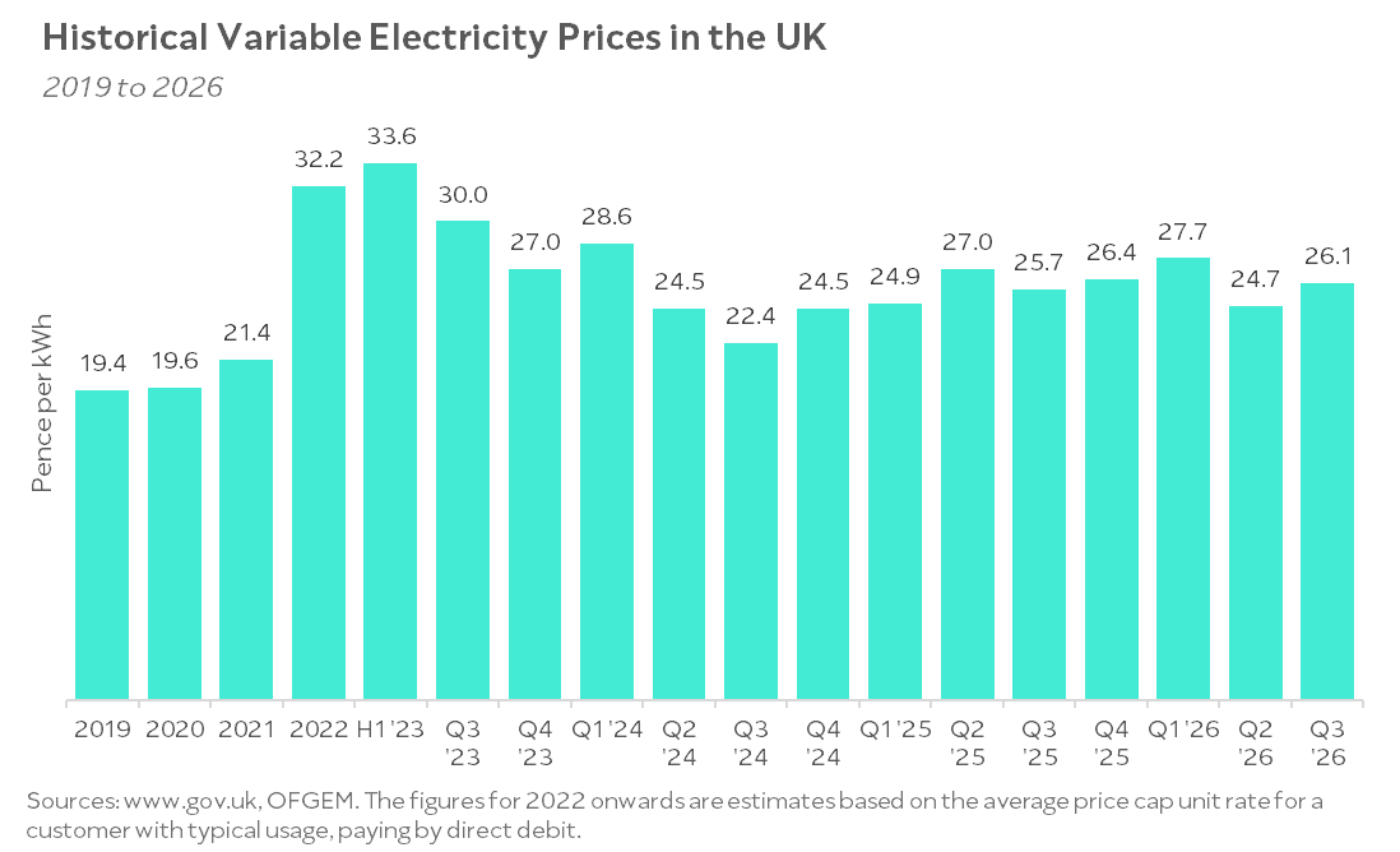
While it's hard to miss the recent energy price explosion of the past few years, in fact, energy prices have been rising for a few years even before that. For example, average unit costs had already risen a remarkable 67% from 2017 to 2021. This historical average unit cost data is based on total bills as produced by the Department for Business, Energy & Industrial Strategy. We've used these figures which are based on fixed consumption rates to look at how unit electricity prices have changed over time, but since they are based on a fixed consumption rate you'll notice they differ from the figures shown in the region-by-region analysis.
These historical figures represent the average across all payment methods.
| Year | Unit cost (pence per kWh) |
|---|---|
| 2010 | 12.7 |
| 2011 | 13.7 |
| 2012 | 14.5 |
| 2013 | 15.2 |
| 2014 | 15.6 |
| 2015 | 15.4 |
| 2016 | 15.4 |
| 2017 | 16.5 |
| 2018 | 17.8 |
| 2019 | 19.4 |
| 2020 | 19.6 |
| 2021 | 21.4 |
| 2022 | 32.2 |
| 2023 (first half)^ | 33.6 |
| 2023 (third quarter)^ | 30 |
| 2023 (fourth quarter)^ | 27 |
| 2024 (first quarter)^ | 28.6 |
| 2024 (second quarter)^ | 24.5 |
| 2024 (third quarter)^ | 22.36 |
| 2024 (fourth quarter)^ | 24.5 |
| 2025 (first quarter)^ | 24.86 |
| 2025 (second quarter)^ | 27.03 |
| 2025 (third quarter)^ | 25.73 |
| 2025 (fourth quarter)^ | 26.35 |
| 2026 (first quarter)^ | 27.69 |
| 2026 (second quarter)^ | 24.67 |
| 2026 (third quarter)^ | 26.11 |
^The actual figures paid will differ and can only be known after the time has passed; the estimate is for a direct debit payment method based on the EPC.
Cheapest car insurance providers RANKED
- Save money with our rundown of the cheapest and best providers, updated weekly
Tell me more
Energy Cost POLL: How are recent energy price rises affecting you?
Please tell us how you're being affected by rising energy prices. Are you turning down the thermostat? Are you more careful of other household budget items like food? Or are you able to absorb the increased rates without having to make sacrifices to other areas of your budget or your comfort? We would like to know.
Energy Market Prices
The data above is historical, but in the current environment most of us want to know what's happening with energy prices now—and where they'll be in the future. A good tool for that is checking futures prices. Futures prices tell you where the market is pricing something in the future. (Read more about futures contracts at the end of the article, if you're interested.)
Let's consider the futures prices for UK natural gas. (Why natural gas? Electricity generation in the UK comes from many sources, such as natural gas, coal and renewables. Natural gas is the largest contributor to UK electricity generation, so natural gas prices have a big impact on electricity prices.)
For example, we could look at the December 2026 natural gas futures to get an idea of what prices are expected to be for next winter—if they're expected to be as bad as they have been, or any cheaper.
The chart below shows futures prices as of May 2026 in orange, and what the futures prices were back in August 2022 (light teal) and January 2026 (dark blue). We've also included the historical close prices in gold (these are essentially the actual, historical wholesale costs at a given time). As you can see, the futures prices indicate that expectations for natural gas prices increased dramatically in August 2022 (light teal).
Between January and April 2026, natural gas futures for May 2026 rose 104% from 65.92 at the end of January 2026 to 134.09 on 7 April 2026. Futures are now down to 113 at the end of May 2026.
While it looks as though it could take a few more years to return to previous prices, wholesale prices are near levels seen at various points in the 2010s. And it appears that the market expects energy prices to remain somewhat steady over the next year, albeit falling somewhat from here.

Another reason that energy prices still feel very high right now is that we'd gotten used to lower electricity bills in 2020. With demand lower at the time, prices dropped. Now, the rising prices feel even more shocking coming off of such low rates.
Why are energy prices so high right now?
Energy prices are high around the globe. It's not just the UK suffering from higher energy prices. There are a number of factors at play in addition to the Russian invasion of Ukraine. Here's a quick overview:
- The Iran conflict is driving up wholesale gas prices. The war in Iran is driving up wholesale gas and power costs, pushing the energy price cap up 13% from 1 July — the biggest increase since 2023 — putting the average household bill at £1,862 a year. Wholesale gas prices in the UK are spiking in 2026 specifically because of the US/Israel-Iran conflict.
- The UK is heavily dependent on imported gas. The UK is more dependent on gas imports than on generating its own energy, which makes it more susceptible to wholesale price changes than other countries. Because gas-fired power plants generate much of the UK's electricity, gas sets the price of electricity 98% of the time — compared to just 7% of the time in France, which relies mainly on nuclear power.
- Policy and network costs are structurally high. Electricity is expensive in the UK because of rising policy and network costs. In the medium and long term, these are expected to continue driving energy bills upward.
- Growing demand is outpacing supply. With the UK electrifying its heating and transport systems, demand for electricity is set to rise sharply, and supply may struggle to keep up with this level of growth.
- Geopolitical volatility more broadly. Wars in oil-rich countries and conflicts between countries over gas pipelines can impact wholesale prices. In the past, temporary spikes have also been triggered by industrial action at power plants and fuel transport issues.
- Second-round inflation effects. Businesses are facing immediate cost pressures from higher energy costs being passed on to consumers, and inflation is expected to re-accelerate, potentially peaking at 3.6% in September 2026 due to higher wholesale energy prices.
However, rates vary according to how you pay. While Northern Ireland tops the charts for highest prices for direct debit options, those living in Merseyside & the South West paid the highest prices for electricity bills that work on credit (i.e. you pay when you receive your bill, typically every three months) and prepayment.
NEW POLL: Do you think the government should help?
How would you feel about the government subsidising energy bills above a certain point?
Standing (Fixed) Charges for Electricity in the UK
Below are electricity standing charges by region from 1 July 2026. The most expensive region is N Wales and Mersey, where residents will pay an average of £246 excluding VAT (direct debit) per year for their standing electricity charge, according to the latest EPC announcement. This is 18% more than the UK average. A standing charge is like the line charge on your landline telephone—it's a fixed cost you'll pay regardless of how much energy you use.
The 2nd highest standing charges are in Yorkshire (£224) and the Northern area (£223).
Northern Ireland is the only area in the UK where you don't pay a standing charge on standard electricity contracts (however, time-of-use contracts like Economy 7 may have a standing charge in NI).
The cheapest standing charges are found in London, where households pay 22% less than average (£156 per year with direct debit, excluding VAT).
| Average standing cost (£/year) by area | Direct Debit | Standard Credit | Prepayment Meter |
|---|---|---|---|
| North West | £165.50 | £192.96 | £165.50 |
| Northern | £223.48 | £254.51 | £223.48 |
| Yorkshire | £223.79 | £254.74 | £223.79 |
| Northern Scotland | £200.04 | £229.16 | £200.04 |
| Southern | £172.77 | £202.72 | £172.77 |
| Southern Scotland | £223.08 | £252.99 | £223.08 |
| N Wales and Mersey | £245.97 | £276.80 | £245.97 |
| London | £155.68 | £181.21 | £155.68 |
| South East | £189.27 | £220.14 | £189.27 |
| Eastern | £187.52 | £218.09 | £187.52 |
| East Midlands | £186.33 | £215.99 | £186.33 |
| Midlands | £207.57 | £237.68 | £207.57 |
| Southern Western | £201.24 | £232.42 | £201.24 |
| South Wales | £201.07 | £230.14 | £201.07 |
| GB average | £198.81 | £228.54 | £198.81 |
Here's How Your Electricity Costs Change with Payment Type
How you pay for electricity (i.e., credit, direct debit or prepayment) will affect both your variable unit charges and your standing charges.
What's the cheapest way to pay for electricity?
Paying with a regular direct debit has historically been the cheapest way to buy electricity in the UK for quite a while; that is, direct debit contracts have the lowest variable unit prices on average.
Prepayment meters have historically had the highest standing (fixed) charges, costing households an additional £25 per year vs. paying via direct debit on average. But now standing charges are the same for direct debit and prepayment—with standard credit customers paying around 10% more for the per-day charge (equivalent to around an extra £30 per year). But variable charges are a different story, where from 1 January 2026 PPM is 3.1% cheaper per kWh than direct debit (and 8.2% cheaper than standard credit).
| July to Sept 2026 Energy Price Cap by Payment Type (Electricity): p/kwh ex VAT | Direct Debit | Standard credit | Pre-payment meter |
|---|---|---|---|
| North West | 24.9 | 26.3 | 24.1 |
| Northern | 24.0 | 25.4 | 23.3 |
| Yorkshire | 24.1 | 25.4 | 23.4 |
| Northern Scotland | 25.2 | 26.6 | 24.4 |
| Southern | 25.2 | 26.6 | 24.4 |
| Southern Scotland | 24.6 | 26.0 | 23.9 |
| N Wales and Mersey | 26.3 | 27.8 | 25.5 |
| London | 25.1 | 26.5 | 24.3 |
| South East | 25.4 | 26.8 | 24.6 |
| Eastern | 25.1 | 26.5 | 24.4 |
| East Midlands | 23.9 | 25.2 | 23.2 |
| Midlands | 24.1 | 25.5 | 23.4 |
| Southern Western | 25.1 | 26.5 | 24.4 |
| South Wales | 25.1 | 26.5 | 24.3 |
| GB average | 24.9 | 26.3 | 24.1 |
If you're looking to save money on your electricity bills, avoid paying via credit as this is now the most expensive payment method in terms of both variable and fixed costs. Those wanting to save can switch tariff or supplier. To learn more, see our guide on Energy Switching.
Are Single or Multi-Register Metering Electricity Rates Cheaper?
You don't hear much about Economy 7 tariffs anymore, but there are Multi-Register Tariffs other than Economy 7 Tariffs including time-of-use tariffs or tariffs where different rates apply to different consumption purposes (e.g. to charge an EV). Is it cheaper to use a multi-register tariff?
Generally, yes, multi-rate are cheaper than a single-rate metering tariff. Multi-register metering tariffs have cheaper per-unit rates by around 11% on average vs. a normal, single rate tariff in 2026, but standing charges are around the same (for direct debit or standard credit payment methods).
| Standard vs. Multi-Register Tariffs | Avg unit price (p/kWh) | Avg fixed cost (£/year) |
|---|---|---|
| Single rate | 27.69 | £199.84 |
| Multi rate | 24.53 | £199.14 |
Can you actually save money with a multi-rate tariff? It depends on when you use your electricity. Electricity drawn during the more expensive hours (e.g. afternoon and evening) will cost you more than a single rate tariff. But drawing at cheaper times (e.g. during the night to fill a home battery for use later) will lower your costs of electricity.
How do futures contracts work?
Futures contracts can be confusing, so here's a quick overview. A futures contract is an agreement to buy or sell something (e.g. a commodity or stock) at a predetermined price at a specified time in the future. A futures contract will be for a certain month and year (e.g. August 2026) and the price of that contract indicates what the market thinks the underlying will be trading at in that future month. For example, there'll be a contract for August 2026, one for September 2026, one for October 2026, and so on. The market trades each of these up until the last trading day of the month before, when the contract expires. So, for example, the September 2026 contract will be traded until the end of August 2026.
If you pick a far-out contract, the price for that contract today tells you where the market anticipates the price will be during the month of that contract. If you pick a nearby contract, the futures price essentially gives you more of a current market price. The futures price converges towards the current price, the closer you get to the contract month—this is because there's less guess work involved the closer you get.
And we can use historical futures prices to see what energy prices have been doing up until the current date. For example, we can look back to July 2021 futures prices to see what natural gas was essentially trading at in July 2021. (Futures prices essentially become current prices once you pass the expiration date of the contract.) This is useful for seeing, for instance, how much prices popped up in November/December 2021 compared to prices over the past couple of years.
Note: The ICE UK natural gas futures contracts used in this article reflect the GBP contract price for 1,000 therms of natural gas per day (1 therm = 29.3071 kilowatt hours) per delivery period (e.g. month).
In the current market, if you're on a default rate which is set by the government’s energy price cap then you theoretically may find better value tariffs. If you're thinking of switching read our Energy Switching Guide.
Energy Price Cap (EPC) vs Energy Price Guarantee (EPG)
The EPG expired at the end of March 2024, and is no longer needed. Right now with the EPC lower than the latest EPG, we simply don't need the EPG.
Remember, these EPC and EPG figures represent annual costs for a household with typical use—in fact the EPC and EPG figures are really fixed on a £ per kWh basis, so those with higher usage will pay more and those with lower usage would pay less than the annualised figures.
What if I'm being charged more than the EPC?
The max you'll be charged actually depends on where you live, how you pay/your meter, and your tariff—and may vary from the overall stated EPC. The EPC is for a typical consumer who pays by direct debit and is on a standard variable tariff (aka default tariff). If you pay by credit or PPM, your rates are likely to be higher; if you're on a different tariff your rate will also vary. And your region certainly is a factor, too. For instance, the South West has the highest electricity standing charges in England and London has the highest variable charges (£/kWh)—read about the EPC caps on variable and standing charges by region for the current price cap.