
Should I Buy an Electric Car?
With all of the news about the booming electric car market in the UK you may be wondering—should I buy an electric car, too? Here's what to consider before you decide.
Electric cars typically have lower running costs than petrol or diesel equivalents, but they usually come with a higher upfront purchase price. A government Electric Car Grant of up to £3,750 is available on eligible new EVs costing £37,000 or less, and dealer discounts can bring the price down further—but it's still worth doing the maths for your own situation.
Is an Electric Car Right for You?
There are three important considerations to keep in mind before deciding on an electric car:
- 1. Can you charge an electric car at home or work?
- 2. Do you drive less than the expected real-life range of the car in one go?
- 3. Can you afford a higher initial purchase price to save money on annual running costs?
If you can answer "yes" to these three questions, then an electric car will probably fit your lifestyle. If you've answered "no" to any of them, then an EV might not be suitable for you at this point in your life.
Why It's Important to Charge at Home or Work
While the network of public charging points is continuing to expand, you probably wouldn't want to rely solely on public charging for your electric car (EV). Why? Charging takes a lot longer than filling up the tank on a traditional combustion engine car.
At a typical rapid public charger (50–150kW), most EVs can reach 80% charge in around 20–45 minutes. Ultra-rapid chargers rated at 150–350kW can cut that to as little as 15–20 minutes on compatible vehicles. But you still need to find an available charger and factor in the time, which is why day-to-day home or workplace charging is far more convenient for most drivers.
In fact, if charging at home or work is possible for you then you may find driving an EV to be more convenient than driving a petrol or diesel—there's no need to drive out of your way to top up at a petrol station!
What's your Daily Mileage?
As long as in your typical day you drive less than the expected real-life range of your electric car (and you can charge at home or work), you should never run afoul of one of the biggest concerns surrounding electric cars—will my battery run out when I'm out driving?
Even used versions of most EVs with the smallest batteries should deliver over 100 miles of real-world range, which is more than enough for the typical driver. For reference, the average car in the UK is driven 7,100 miles a year, or around 19 miles a day. (Learn more about how electric car batteries deplete over time in our articles on Tesla battery degradation and Nissan Leaf battery degradation.)
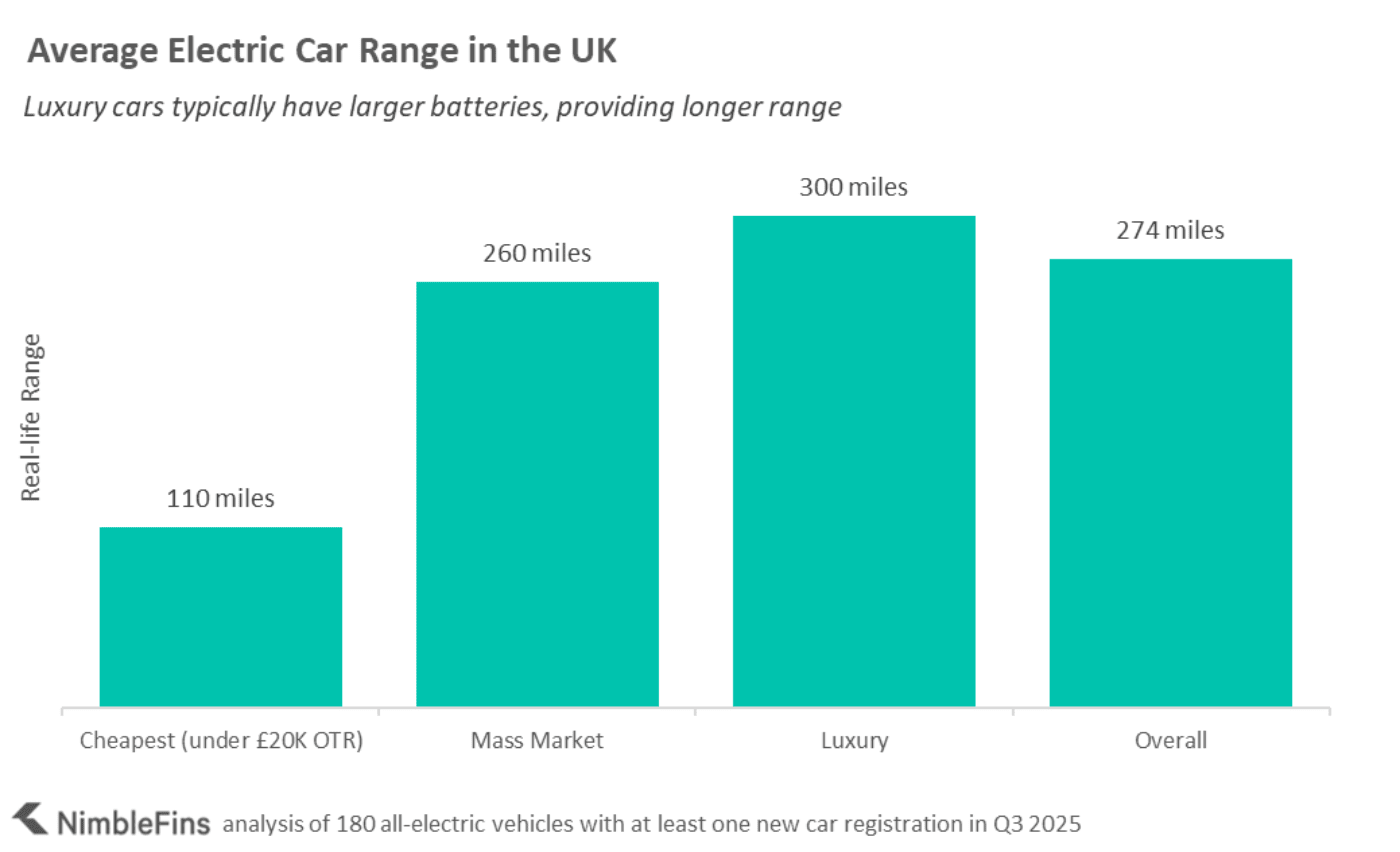
Even the cheapest new electric cars now deliver around 110 miles of real-world range on average. More expensive cars typically have larger batteries, and consequently longer range. Below is a table showing figures from our average EV car range article.
| Average Electric Car Range UK | Typical Battery Size (kWh) | Real-life Range (miles) |
|---|---|---|
| Cheapest (under £20K OTR price) | 26 | 110 |
| Popular Mass Market | 63 | 260 |
| Popular Luxury | 77 | 300 |
| Popular overall | 68 | 274 |
If you regularly drive very long distances, some EVs may not be as suitable—though the range figures above cover the vast majority of UK drivers' daily needs.
Costs: Electric vs Petrol
Purchase Price
The cheapest new electric car on the UK market is currently the Dacia Spring Electric at £15,990, according to our research on electric car costs. The average mass market (non-luxury) electric car costs around £36,475—which is just under the £37,000 threshold for the government's Electric Car Grant of up to £3,750, applied automatically at the point of sale.
| How much does an electric car cost? | |
|---|---|
| Cheapest electric car (Dacia Spring Electric) | £15,990 |
| Mass market (non-luxury) electric cars | £36,475 |
| All UK electric cars | £41,078 |
| Luxury electric cars | £51,945 |
| Most expensive electric car (Rolls-Royce Spectre) | £330,000 |
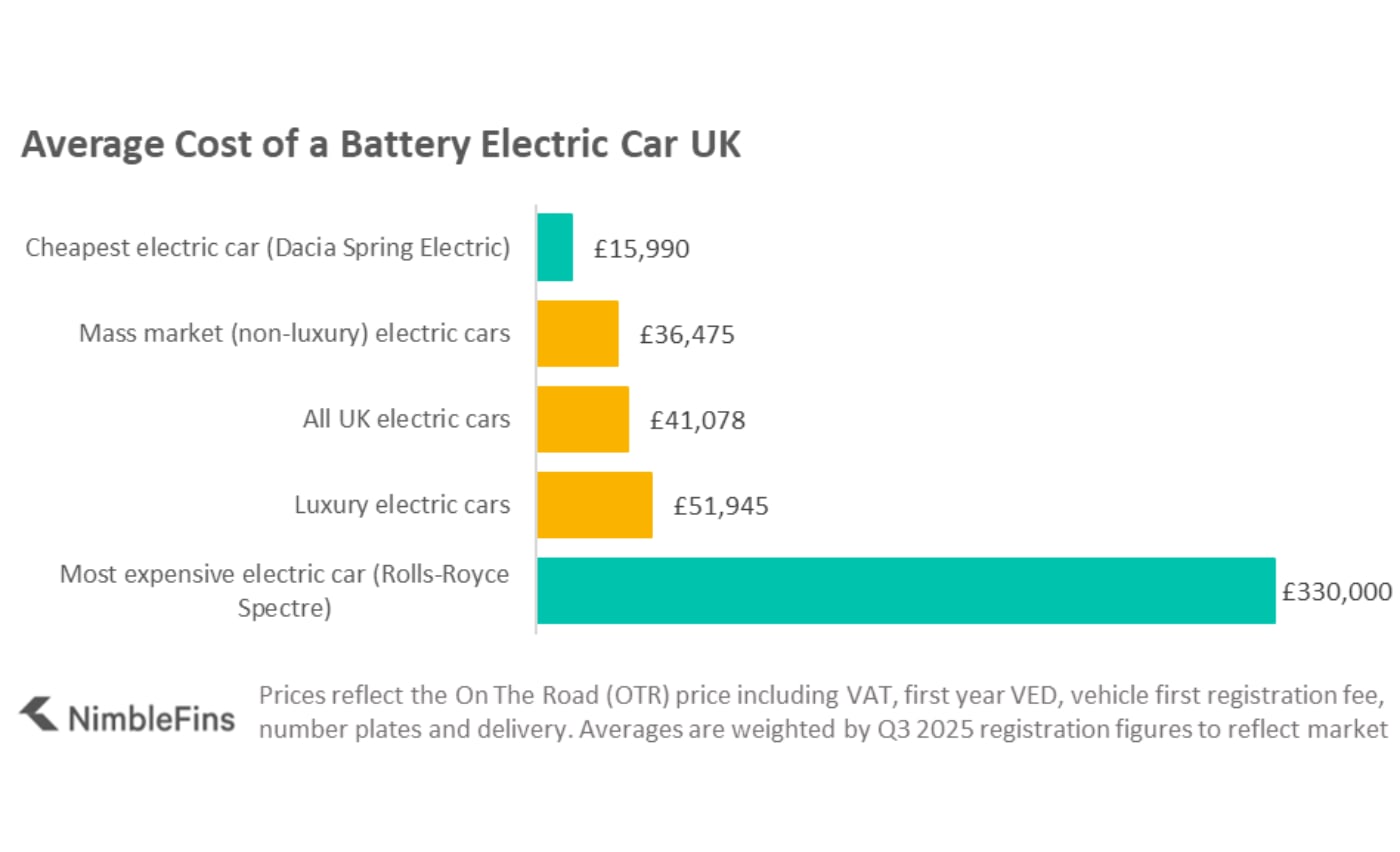
That said, the average across all UK electric cars, including luxury models, is £41,078—higher than a comparable petrol car. The average cost of a small petrol car in the UK is around £20,000, so even after the grant, most EVs carry a higher sticker price. This means the savings in running costs take a number of years to offset that difference, making EVs a better financial proposition for drivers who plan to keep their car for the long term.
Running Cost Savings
In our article on Annual Cost Savings with an Electric Car, we calculated the estimated savings from driving an EV compared to a petrol car. The table below summarises what an average driver can expect.
| Electric Car vs Petrol Car: Annual Savings | Per Year (until 2025) | Per Year (from 2025) | Over 5 Years |
|---|---|---|---|
| Vehicle Tax Savings (depends on year and vehicle list price) | £165–£190 | £86 (average)^ | £430 |
| Estimated Fuel Savings (depends on vehicle, mileage and electricity/petrol prices) | ~£579 | ~£579 | ~£2,895 |
| Estimated Total Savings | £744–£769 | ~£665 (average) | ~£3,325 |
^Vehicle tax savings are lower from 2025 because EVs, which previously paid no Vehicle Excise Duty (VED), now pay a small amount. See our EV savings article for full details.
So while the savings are real—around £665 a year and £3,325 over five years on average—they need to be weighed against the higher upfront purchase price. The longer you keep the car, the more favourably the maths stacks up.
The Government Electric Car Grant
A new Electric Car Grant launched in July 2025 and is confirmed to run until 2028–29. It offers a discount of up to £3,750 (Band 1) or £1,500 (Band 2) on new electric cars priced at £37,000 or less. The discount is applied automatically at the point of sale—you don't need to apply. The grant level depends on how sustainably the vehicle is produced, including how the battery is manufactured.
Separately, if you are a renter or flat owner with off-street parking, you may be eligible for the EV Chargepoint Grant, which covers 75% of the cost of buying and installing a home charging unit, up to £350 — rising to £500 from April 2026. You can check currently eligible cars and full grant criteria at gov.uk.