
Inheritance tax threshold
Inheritance tax (IHT) is back in the spotlight as speculation mounts over what the Chancellor will announce in the Autumn Budget this November. The threshold at which estates begin to pay IHT has been frozen for over a decade, dragging more families into the net as property prices and asset values rise.
The Government has so far resisted calls to raise the £325,000 threshold, arguing that IHT affects only a small proportion of estates. Yet critics say the tax is increasingly unfair, hitting middle-class households in the South East particularly hard due to high property prices, while wealthier families can often avoid it through careful planning.
In fact, had the £325,000 threshold increased in line with inflation every year since it was last raised in 2009, the threshold would actually be £523,000 today, based on inflation figures from the Office for National Statistics:

Chancellor Rachel Reeves has pledged to “review unfair tax breaks”, and has already scrapped inheritance tax relief for agricultural estates, fuelling expectations that more reforms could be announced on November 26.
And with pressure on to close the estimated £40 billion gap between Government spending and revenue, Ms Reeves could reduce the threshold or tighten exemptions.
What is clear is the tax is biting more people each year, with new analysis by NimbleFins revealing record numbers of estates now liable.
What is the inheritance tax threshold?
The inheritance tax threshold – also known as the nil-rate band – is the value of an estate that can be passed on tax-free. Anything above this threshold is taxed at 40%.
Currently, the nil-rate band is set at £325,000 per person. This has not changed since 2009, despite house prices more than doubling over the same period.
There is also a residence nil-rate band, introduced in 2017, which allows an extra £175,000 to be passed on when the family home is left to direct descendants. This means an individual can pass on up to £500,000 without paying IHT, or £1 million for a married couple.
Inheritance tax threshold over time
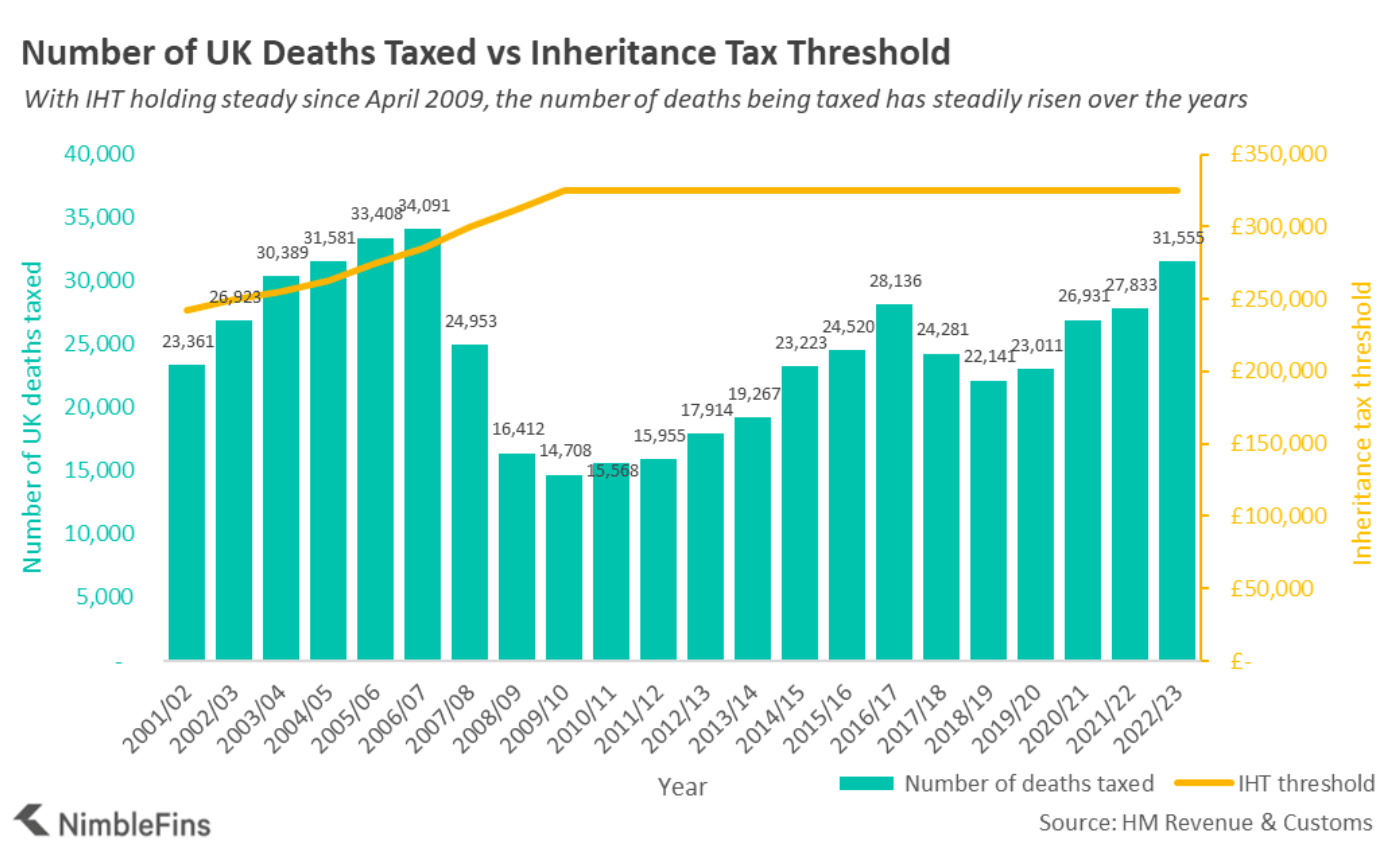
Because the inheritance tax threshold has been frozen for 14 years, the number of estates paying inheritance tax has surged.
NimbleFins analysis of HMRC data shows about 31,500 estates paid IHT in 2022/23, the highest figure since the threshold was first raised to £325,000 (in 2009), and the fourth highest in the last 20 years.
This chart illustrates how the number of deaths resulting in an IHT charge has fluctuated over the past two decades, falling sharply after the financial crisis but climbing steadily since 2010.
| Tax year | Number of deaths taxed |
|---|---|
| 2001 to 2002 | 23,361 |
| 2002 to 2003 | 26,923 |
| 2003 to 2004 | 30,389 |
| 2004 to 2005 | 31,581 |
| 2005 to 2006 | 33,408 |
| 2006 to 2007 | 34,091 |
| 2007 to 2008 | 24,953 |
| 2008 to 2009 | 16,412 |
| 2009 to 2010 | 14,708 |
| 2010 to 2011 | 15,568 |
| 2011 to 2012 | 15,955 |
| 2012 to 2013 | 17,914 |
| 2013 to 2014 | 19,267 |
| 2014 to 2015 | 23,223 |
| 2015 to 2016 | 24,520 |
| 2016 to 2017 | 28,136 |
| 2017 to 2018 | 24,281 |
| 2018 to 2019 | 22,141 |
| 2019 to 2020 | 23,011 |
| 2020 to 2021 | 26,931 |
| 2021 to 2022 | 27,833 |
| 2022 to 2023 | 31,555 |
Rachel Reeves inheritance tax changes
Speculation is mounting that Chanceller Rachel Reeves could change the threshold in the Autumn Budget on November 26, or crack down on tax reliefs.
Insiders suggested the Chancellor may look at curbing reliefs used by the wealthy, following her axing of agricultural relief when farms are passed down to children.
Treasury officials are looking at the impact of tightening rules on the gifting of money and assets, the Guardian reported.
NimbleFins previously explained how inheritance tax tapering works when it comes to gifting money.
Although it’s not looking likely, if Rachel Reeves was to increase the inheritance tax threshold in line with inflation since 2009, £325,000 should rise to £523,000.
Inheritance tax threshold for married couples
For married couples and civil partners, the inheritance tax rules are more generous. When one partner dies, assets can usually be passed to the survivor free of IHT.
In addition, any unused portion of the nil-rate band can be transferred to the surviving partner. This means couples can effectively combine their allowances to leave up to £1 million tax-free if they also use the residence nil-rate band.
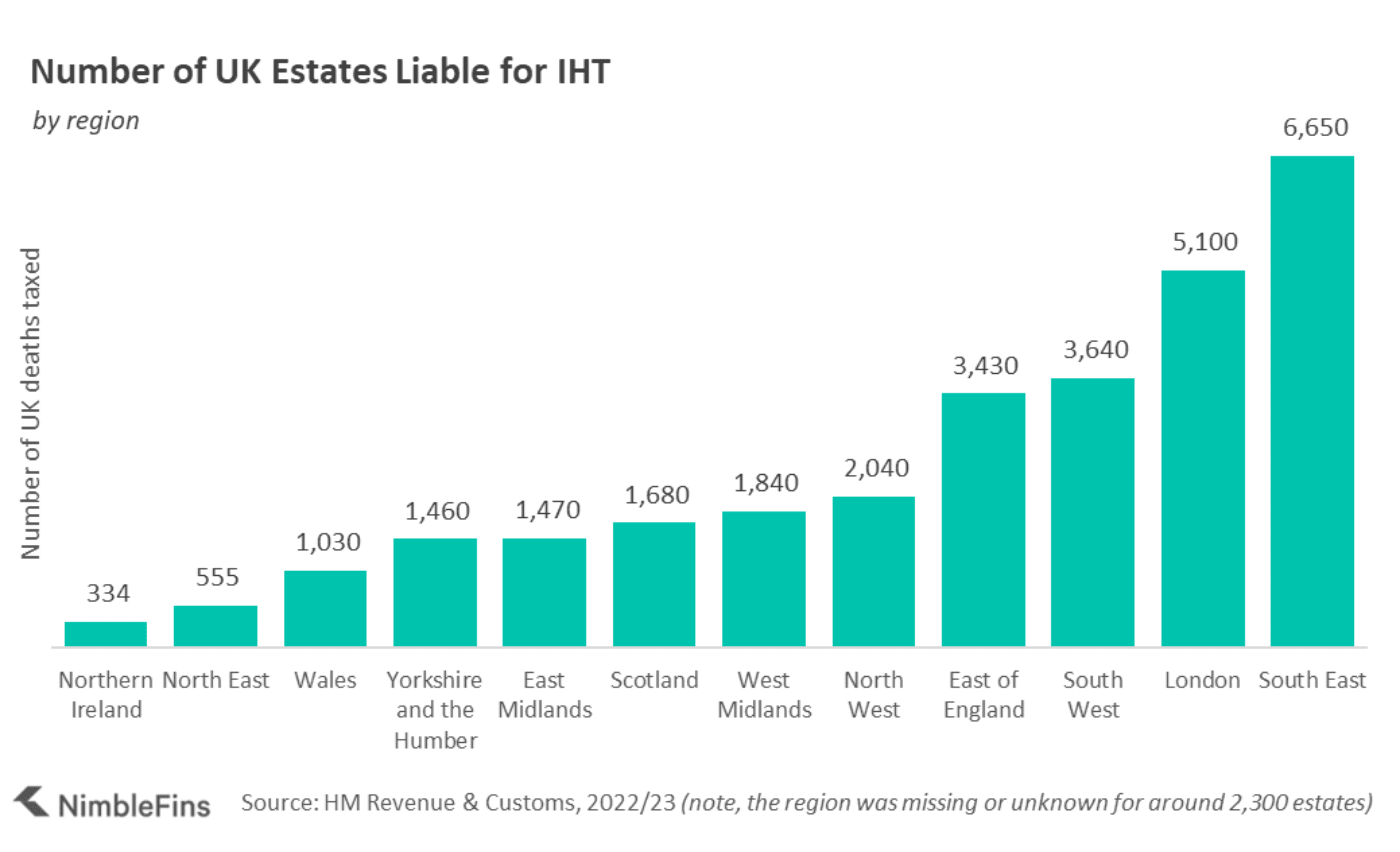
This is particularly significant in the South East and London, where property values often exceed the individual £325,000 threshold. Indeed, NimbleFins research shows the South East had the highest number of estates liable for IHT in 2022/23, at 6,650, followed by London with 5,100.
| Region | Number of estates paying IHT |
|---|---|
| North East | 555 |
| North West | 2,040 |
| Yorkshire and the Humber | 1,460 |
| East Midlands | 1,470 |
| West Midlands | 1,840 |
| East of England | 3,430 |
| London | 5,100 |
| South East | 6,650 |
| South West | 3,640 |
| Wales | 1,030 |
| Scotland | 1,680 |
| Northern Ireland | 334 |
| Unknown, missing or other | 2,320 |
| Total | 31,549 |
Read more: